Good Neighbours.

Good Neighbours

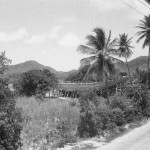
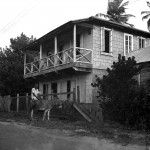
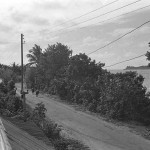
Living just south of town on the road to the airport provided us with a number of advantages; we were next to the beach, we could walk easily into town, we were out of the way and we had good neighbours.

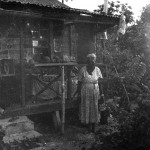
Tan-Se-Se lived directly beside our house. She was a grand old lady who had beneath her roof children, grandchildren and other children she had ‘taken in’.  She had, I was told, been a teacher in one of the primary schools but was by then long retired.

Her house was not grand, far from it. In fact it was a small single storey building with wooden walls and a corrugated tin roof in the vernacular style of local housing. In the front were a few stone steps leading to a narrow veranda. Behind the front door was a single living area with a few sticks of furniture. There was, I think, a couple of bedrooms and a small kitchen out the back.

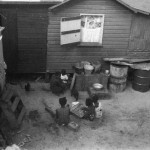
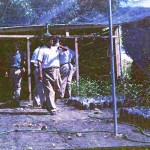
At the side of the house stood a small rickety shed along with two or three oil drums. These were used to catch the rainwater off the roof; their only water supply. In the small courtyard a few chickens pecked and ran about. It was here that the children often sat and played.

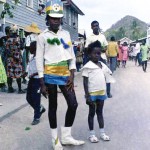
Two of the children were Mary (aged around 10) and Hannah (probably around 6yrs old). Mary would often come round to our house and chat with Cathy. Cathy played guitar and I think Mary liked to hear her play and sing; as we all did.

Tan-Se-Se kept a watchful eye over us and would often send Mary round with useful advice or just to see how we were doing. On one occasion I had been out snorkelling and had caught some fish for our tea. One was a Goat fish and Tan-Se-Se had obviously noticed as I carried it home. I was sitting in the yard about to prepare the fish when I was suddenly aware of Mary standing by my shoulder.

‘Tan-Se-Se say don’t eat de head. De head is poisonous’, Mary commented advisedly. She then leaned over and deftly pointed at the Goat fish. ‘Dat is de head’, she said, just making sure I was in absolutely no doubt.

Living all together in this small ‘shack’ appeared to be extremely cramped but I never heard any of them complain. In fact they all seemed extremely happy. The children were always full of fun and played outside all day long.

I’d not heard from Mary for over forty years and then, a few weeks ago, I received an email from her. In her letter she described what Christmas had meant to her as a child in Carriacou. I was touched by her sincerity as she simply recalled the pleasure of Christmas as she remembered it. I repeat her words here for you now and hope you enjoy her description as much as I did.

‘This website has brought fond memories of my Xmas on the Island of Carriacou. Weeks leading up to Xmas, there would be toys in the shop windows, thinking back it was the same toys every year, but nevertheless it was exciting to see. There would be some little white dolls, mouth organ, Christmas stockings with sweets and small toys and everyday after school I’d be eyeing these toys up. In the eyes of a child in Carriacou they were the most amazing toys ever.
I can’t remember exactly, but I think its a few days before Xmas ,when we had what was called ‘shopping day’, when I would be able to spend money given alongside other monies collected from family, family friends, tourists. I would buy a doll, mouth organ and cakes. That was a looovely day!
On Christmas morning, you would eat cake/ham/drink ginger beer and all bands would come round seranading, and everyone would join in singing and dancing. We would then make our way up to the town centre, where Santa would arrive on a boat and hand out presents to the poorer children. You knew he was coming because they would blow the conk shell to let everyone know he was landing. There would be a big Xmas tree in the market square, with presents hung up on the tree.
Although I didn’t attend the midnight mass, I knew that everyone would start jumping up to the steel band after the mass. Oh it was so lovely-going down memory lane.’

When I finally left Carriacou to return to England, Mary gave me a small coaster to take with me. I kept it for many years in my parents’ home. Unfortunately, when their house was sold and the contents removed, the coaster was lost. However, the memories remain and I can honestly say that Tan-Se-Se and her family were very special neighbours indeed.

Posted in Good Neighbours | Tagged , , , , | Comments Off on Good Neighbours.

Lighter Moments with Father Fitton.

Lighter Moments with Father Fitton

Carriacou’s Paracletes

The Catholic diocese of Carriacou was administered by The Paraclete fathers. The two permanent priests on the island at the time were Father Fitton and Father John. Both were Americans and they fitted comfortably into Carriacouan society.

One of the regular social gatherings in Carriacou at the time was Thursday’s dinners at their residence behind the Catholic church. The evening consisted of a meal followed by a variety of musical entertainment. Various local musicians would play regular calypsos as well as their own creations. A regular contributor was ‘The Mighty Scraper’ and his calypso band, ‘The Flames’. I distinctly remember him singing his own calypso, Blackie. The chorus went something like this:

Blackie why you teef Bullen pantie?

Blackie why you teef Bullen pantie?

You went into Bullen’s store and you make a grab

And you put a red pantie down inside your bag.

The Parochial Yacht

In order to be able to attend to services on surrounding islands the fathers’ had a small yacht to transport them. On one occasion, the yacht was being sailed to Grenada for an engine overhaul. Close to ‘Kick ‘em Jenny’ a contrary wind sent the boom flying across the deck hitting Father Fitton squarely in the back and knocking him overboard. One of the crew dived in to save him whilst the other deftly manoeuvred the yacht round and pulled them back on board. (The two lads may have been Desmond and Fortune but I’m not sure. Does anyone remember?)

Some days later I met Father Fitton and he described the incident to me. He said that his habit had inflated and kept him afloat. He also added, somewhat whimsically, that he had experienced a final thought as he became unconscious. I was curious to know what this ‘spiritual’ revelation might have been.  Imagine my surprise when he said he had thought, ‘I’m glad I didn’t give up smoking because cancer hasn’t got me in the end.’

Posted in Lighter Moments with Father Fitton | Tagged , , , | 1 Comment

Eric Gairy Visits Carriacou.

Eric Gairy Visits Carriacou.

Making ‘Uncle’ Eric.

Eric Gairy was elected ‘Premier’ in late 1967. He made a point of travelling to Carriacou soon after. Despite huge popularity in Grenada, Gairy was not Carriacou’s favourite politician. That accolade seemed to go to local man, Herbert Blaize, leader of the GNP, who lived in Hillsborough next to the Sports Ground. Gairy had a lot of his own ground to make up and he wasted no time visiting the island.

Gairy had been in government in the 1950’s. In the aftermath of hurricane ‘Janet’ in 1956 he was accused by the British Government of using funds , allocated to Grenada for clearing up the damage, for his own personal use. This accusation, bizarrely described as ‘squandermania’ led to Britain suspending the constitution in 1961. Gairy, as Chief Minister and Minister of Finance, was reputedly interred on a British frigate and thence taken to Govt House at Top Hill, Carriacou. Legend has it that the British tried to force him to sign a document stating he would never again participate in politics in Grenada. He reputedly threw the pen back at his tormentors and refused to sign.

It would seem that this act of defiance was duly noted by Grenadian citizens and the following year he was restored to his vacant seat. In 1967 the Associated Statehood Act granted the Grenada Government full autonomy over its internal affairs. In the election which followed Gairy and his GULP party was voted into power.

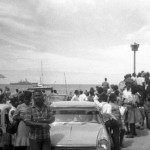
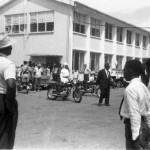
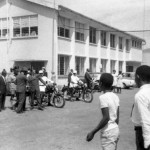
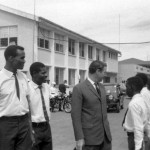
He paid two visits to Carriacou, one on Thursday. 10th Feb. 1968 and another on Tuesday 19th March 1968.  As if to lay the ghost of his internment he arrived for his second visit on a British frigate, accompanied by Mr Turbott, the British appointed Governor.

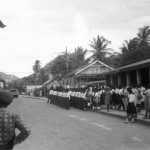
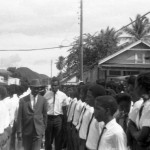
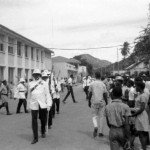
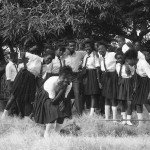
Bishop’s College students turned out in force to greet the visiting dignitaries. Students lined up in the Market Place and were introduced by Mr Alleyne and Rodge Gay.

As I said, Gairy had arrived on Carriacou with a bit of a hill to climb to win over the people. He reputedly did this with one stroke of political acumen and showmanship. As the motorcade made its way around the island, Gairy is said to have spotted a labourer working by the side of the road. He must have noticed he was barefoot. He appears to have stopped the whole motorcade, approached the man and handed him a personally written note to take to Bullen’s store to exchange for a pair of boots.

Faster than semaphore, news of this incident sped back to Hillsborough and by the time the motorcade arrived back in town Gairy had been euphemistically transformed into ‘Uncle Eric’ and his reputation as ‘a man of the people’ had been dramatically enhanced.

Posted in Eric Gairy Visits Carriacou. | Tagged , , , , , , , | Comments Off on Eric Gairy Visits Carriacou.

Farmers’ Day Out


Farmers’ Day Out on Friday 15th Dec. 1967

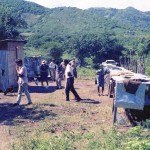
The Farmers’ Day out was organised by Mr Barratt and the Agricultural Dept. As well as being a great day out it gave a good insight into some of the different features of agricultural life around the island. George and I joined the bus and we ended up having a really interesting day. My diary reads:

’10.00a.m. and I looked outside to see a bus full of enthusiastic people and realised this was the bus for ‘The Farmers’ Day Out’. We dropped everything, jumped on the bus and went hurtling off on the tour.

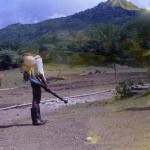
First stop was the Craigston estate. Craigston is the largest estate on the island and is managed by a Grenadian called Mr Kent. The estate is owned by his brother. He took us around to show all his good work clearing cacti from the land. We had to wade through dense weeds and high thicket before we reached the spot. I don’t think the men were too impressed and we left soon afterwards. Mr Kent seemed quite put out that no-one wanted to visit his sheep pens.

Next stop was the Lime Crushing Plant. Inside there was one large machine into which the limes were dropped and crushed. Some of the men were covered in bleached areas of skin: the result of acid from the limes.

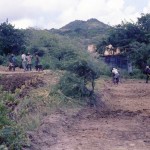
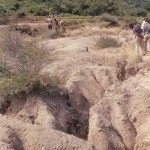
We were then taken to visit areas of soil erosion in Belmont. Top soil had been washed away and deep gullies had formed. Concrete barriers have been built across the gullies to try and hold back the remaining soil. They seem to have some effect but we were told that because land was so scarce people were continuing to plant right up to the edge of the gullies and, in those circumstances the erosion spreads beyond the ends of the barriers.

It struck George that there was a lot of work here which could be undertaken as a school project and a ‘conservation group’ might prove to be a worthwhile venture.

For our penultimate destination Mr Barratt took us around the Botanical Gardens where he gave a most interesting talk on the work that was being done here.

Finally, we stopped off at Mr Barratt’s house and we were fed platefuls of chicken pillau washed down by a couple of ‘jacks’.

N.B. For a thoroughly interesting account of the history of Craigston could I recommend a PDF file titled, ‘Craigston and Meldrum Estates, Carriacou, 1769 – 1841 by H. Gordon Slade’.

Also: a detailed book, ‘Up Before Dawn’ by Edward Kent.

Posted in Farmers' Day OUt | Tagged , , , , , , , | 3 Comments

Bishop’s College Field Trip

Bishop’s College Field Trip

February 1st 1968

Teaching Conundrums at Bishop’s College.

Whilst teaching GCE ‘O’ Level Geography and some 4th year Biology I was somewhat surprised  how much of the GCE syllabi were based on examples from the UK. It shouldn’t have been a surprise really since the exam board was based in England. For example, most of the map work took examples from UK Ordnance Survey maps such as the Cumbrian Lake District. Now don’t get me wrong, it’s a fine region to study and the 1” OS map gives a tremendous amount of information but was it directly relevant to students in the Grenadines? Equally, in Biology, the main flowering plant students had to study was the Buttercup.

Now, I ask you, we were in a Tropical Paradise surrounded by the most wonderful plants and we were being asked to study the ‘English’ Buttercup. It just didn’t seem right.

I kind of felt there was a need for a bit more balance and with Mr Alleyne’s support I introduced some local examples into my teaching. My first ‘deviation’ was to

‘ take 5B into town to make a building survey in Hillsborough. We measured out the streets, width and length, made a note of every building and their primary use. We then returned to school and drew out rough maps and categorised the use of the buildings’.

It was a good introduction, I thought, to map work and mapping techniques. Imagine my surprise when, the following day Mr Alleyne came to inform me that ‘some local people had complained to him about students being allowed to roam the streets during mid-morning’.

The finished map work eventually formed one of the central exhibits in an exhibition of students’ work for the Agricultural show and Presentation Evening. I eventually felt vindicated. All credit though to Mr Alleyne who, having understood what I was trying to do, gave me his full support.

Geography Field Trip 01.02.1968

5A’s Geography Field Trip around the island was conceived in the same vein as the mapping project. I planned it as a half day trip around the island stopping at various points to study their Geographical significance. My diary entry for the day reads as follows:

‘This was a half day’s trip for 40 students around the island. I organised it, mainly for 5A but a number of students from 5B and Form 4 came as well. At Limlair we were shown prize bulls. At Mt Pleasant we studied the beach then soil erosion in Bellvue and Harvey Vale. At Dumfries we made a tour of the Lime Crushing Plant. We then stopped for a snack but Vestin and Regina had (allegedly) eaten all the sandwiches. We then looked at the Lime Plantation in L’Esterre, followed up by a visit to the new airport and finally we ended with a talk by Carlyle in the Botanical Gardens’.

Suggested Questions Given to Students

1. Limlair: Experimental Agricultural Station.

What are the aims of the station? What crops and grasses are being grown? What have been the primary results? What are the most important agricultural problems they have to deal with? How are they trying to improve agriculture in Carriacou?

2. Mt Pleasant Beach.

Note the damage done by the removal of sand for the Airport etc.

Draw sketches to show the main coastal features.

Estimate the slope of the beach and tidal range.

3.  Bellvue & Harvey Vale. (Areas of Gully & Sheet erosion.)

What methods are being used to try and reclaim the land? How successful are they?

4. Dumfries Lime Plant.

Note the stages in the crushing process.

How many people work here?

Where do the limes come from? Which estates?

Where does the lime juice/oil go and what is it used for?

5. L’Esterre Lime Plantation.

How and when are the Limes planted? How and when are they cropped?

Note planting distances, soil type and growing requirements.

6. Airport. Built with a grant from the CDC (Colonial Development Corporation).

How long has it taken to build? How will it help Carriacou’s economy? Where will the air routes go? Etc.

7. Botanical Gardens (Experimental Agricultural Station growing every commercial plant found in Carriacou.)

What work is being done here? What have been the results in the re-cropping programmes and the re-nourishment of soils?

Students completed reports on the field trip but the real success of the day was the establishment of a link between BC and the Agricultural Dept. Thereafter, representitives came into college to talk about farming, soil erosion etc. Indeed, they even offered us a piece of badly eroded land so we could try to reclaim it and teach students the value of not planting crops on eroded soil. Sadly, I left before the project could reach fruition and I’m not sure if anything further was done.

Retrospective View

Reading where we went and the things we looked at makes me realise there was a lot going on in the new young state of Carriacou. The whole island oozed a feeling of optimism and there was a determination to solve problems and work for the future. It was a wonderful place to be at a most exciting point in its history.

Posted in Bishop's College | Tagged , , , , , , , , , , | Comments Off on Bishop’s College Field Trip